
SHARE

Share this news item!

Artificial Intelligence: Steering the Maritime Industry Towards a Competitive Future

The Transformative Impact of AI on Ship Design and Operations

Artificial Intelligence: Steering the Maritime Industry Towards a Competitive Future?w=400

The information on this website is general in nature and does not take into account your objectives, financial situation, or needs. Consider seeking personal advice from a licensed adviser before acting on any information.

The maritime industry is undergoing a significant transformation, driven by advancements in artificial intelligence (AI), data analytics, and cloud collaboration.
These technologies are reshaping ship design, operations, and sustainability, setting the stage for enhanced competitiveness in 2026 and beyond.

Connected ecosystems are unlocking economic synergies by integrating design, construction, and operational data. This integration reduces inefficiencies and waste, enabling faster and more cost-effective retrofits. Companies that unify their data flows are poised to outperform competitors still relying on outdated systems.

AI is evolving from a conceptual tool to an operational co-pilot, with applications such as generative AI, agentic AI, and real-time analytics becoming mainstream. AI agents are now capable of autonomously optimizing routes, avoiding collisions, and scheduling port calls, leading to smarter, safer, and more sustainable maritime operations.

Addressing labor shortages, AI serves as a force multiplier for crews and yard workers, automating compliance documentation, retrofit planning, and data handovers. This support enables skilled professionals to manage increasing industry complexity while enhancing operational safety and resilience.

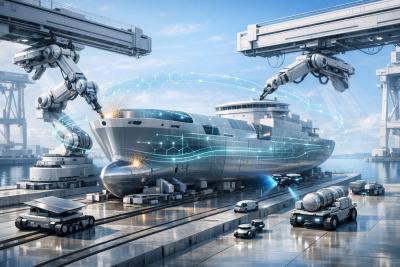
AI is also redefining ship design and construction by embedding design intent into work instructions, tracking progress in real time, and guiding crews through completions using augmented reality. Autonomous systems are coordinating robotics and equipment for optimal quality and resource use, facilitating the production of large, unique components.

As fleets expand and systems become more complex, AI-driven asset lifecycle management ensures that digital twins and associated documentation remain current throughout a vessel's life, providing invaluable insights for continuous improvement.

Collaboration among class societies, original equipment manufacturers, fuel suppliers, and manufacturing partners is becoming essential. Shared digital data enables the integration of innovations, aligning with cargo, bunkering, and materials to create an AI-enabled lifecycle for the next generation of zero-emission vessels.

Published:Friday, 10th Apr 2026
Author: Paige Estritori

Please Note: We do not endorse any specific products or companies. Some content is sourced from third parties, including press releases, and may not be independently verified for accuracy or completeness.

Share this news item:

Finance News

Navigating Break Costs in Fixed-Rate Mortgage Refinancing
21 Apr 2026: Paige Estritori
Refinancing a fixed-rate mortgage can offer Australian homeowners opportunities to secure better loan terms or access additional features. However, it's crucial to understand the potential break costs associated with ending a fixed-rate loan prematurely. - read more
Current Mortgage Refinance Interest Rates in Australia for 2026
21 Apr 2026: Paige Estritori
As of 2026, Australian homeowners are presented with competitive mortgage refinance interest rates, making it an opportune time to consider refinancing. With the Reserve Bank of Australia adjusting the cash rate earlier this year, many lenders are offering refinance options starting in the low 5% per annum range for well-qualified applicants. - read more
